

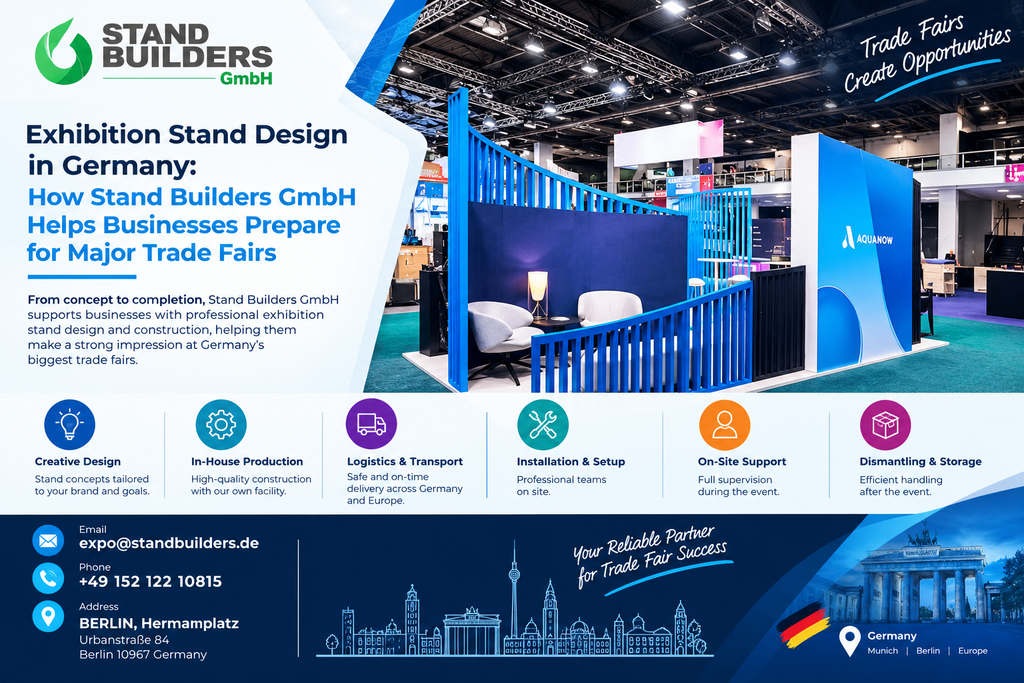
Germany’s exhibition industry offers businesses valuable opportunities to introduce products, connect with international buyers, and establish long-term commercial relationships. However, participating in a trade fair requires more than booking exhibition space and preparing promotional materials. Effective exhibition stand design in Germany involves understanding visitor expectations, organising functional spaces, and creating an environment that communicates a company’s identity. Stand Builders GmbH, a Berlin-based exhibition stand design and construction company, supports exhibitors through coordinated design, production, installation, and on-site services across Germany and Europe.
The Connection Between Exhibition Design and Business Performance
An exhibition stand is often the first physical interaction between a business and its potential customers. Its appearance, layout, and functionality can influence how visitors perceive the company and whether they decide to explore its products or services.
Unlike traditional advertising, exhibitions allow businesses to communicate directly with their audiences. Visitors can examine products, ask questions, attend demonstrations, and discuss possible partnerships.
A well-planned stand supports these interactions by making information accessible and creating comfortable spaces for communication.
For example, an engineering company may need dedicated machinery displays, while a software provider might prioritise digital presentations and demonstration counters. The design should reflect these practical differences rather than follow a standard decorative approach.
This is why successful exhibition planning begins with understanding the company’s commercial objectives and the audience attending the event.
What Makes an Exhibition Stand Effective in a Competitive Environment?
Major German trade fairs bring together exhibitors from different countries and industries. With numerous businesses competing for attention, exhibition spaces must communicate their purpose quickly and clearly.
Several design principles help achieve this balance.
Clear Branding Without Visual Overcrowding
Brand recognition is important, but filling every available surface with graphics can make an exhibition stand difficult to understand.
Effective branding uses consistent colours, readable signage, and carefully positioned messages. Visitors should be able to identify the company and understand its main offering without having to examine extensive promotional material.
Large visual elements can attract attention from a distance, while detailed product information should remain accessible within the stand.
Lighting That Supports Product Presentation
Lighting influences both visibility and atmosphere. Proper illumination can highlight products, guide visitor attention, and distinguish presentation areas from meeting spaces.
Industrial exhibitors may require focused lighting for machinery, while lifestyle brands might prefer softer illumination that complements their products.
Lighting arrangements should also consider power requirements, venue restrictions, and the practical needs of exhibition staff.
Comfortable Movement and Accessibility
An exhibition stand should allow visitors to enter, move between displays, and communicate with representatives without unnecessary obstacles.
Narrow walkways, poorly positioned counters, and excessive furniture can restrict movement, particularly during busy exhibition periods.
Thoughtful spatial planning creates a more accessible environment and supports productive conversations.
Choosing an Exhibition Stand That Matches Your Objectives
Exhibition stand formats vary according to available space, budget, presentation requirements, and the frequency of participation.
Stand Builders GmbH provides four principal exhibition stand solutions designed to accommodate different exhibiting needs.
Custom exhibition stands offer flexibility in architectural appearance, branding, product displays, and internal layout. They are suitable for businesses requiring a distinctive presentation or specialised demonstration areas.
Modular exhibition stands use adaptable structural components that can be configured for different exhibition spaces. They can be particularly useful for companies attending several trade fairs with varying stand dimensions.
Double-decker exhibition stands provide an additional level for activities such as meetings, hospitality, or private discussions. These structures require appropriate engineering and compliance with exhibition venue regulations.
Country pavilion exhibition stands create coordinated presentation environments for groups of businesses, trade associations, or national delegations. They combine a shared identity with individual exhibitor spaces.
Selecting the right format depends on what the company intends to accomplish rather than simply choosing the largest or most elaborate structure.
Frankfurt as an Example of Location-Specific Exhibition Planning
Frankfurt is an important destination for international trade fairs, attracting businesses from industries including automotive technology, consumer goods, manufacturing, and professional services.
Events such as Automechanika, Ambiente, and Light + Building demonstrate the diversity of commercial activities represented in the city’s exhibition calendar.
For participating companies, this variety creates different stand design requirements. Automotive exhibitors may need substantial demonstration areas, while consumer goods businesses often benefit from organised product displays and accessible meeting spaces.
Working with an experienced exhibition stand design company in Frankfurt can help exhibitors coordinate design and construction requirements with the practical conditions of the exhibition venue.
Stand Builders GmbH provides stand design, construction, transportation, installation, dismantling, and on-site supervision services for exhibitors participating in Frankfurt trade fairs.
Why Venue Requirements Matter
Every exhibition venue establishes technical and operational requirements that exhibitors must consider.
These may include permitted stand heights, electrical installations, fire safety measures, loading schedules, and construction deadlines.
A design that works at one exhibition may require adjustments before being installed at another.
Understanding these requirements early helps prevent unnecessary redesigns, transportation complications, and last-minute construction problems.
From Initial Briefing to Exhibition-Ready Construction
Creating a functional exhibition stand requires cooperation between designers, production teams, logistics specialists, and installation professionals.
Stand Builders GmbH follows a structured project process that connects the initial concept with the completed exhibition environment.
Translating Business Requirements into a Design Concept
The process begins with gathering information about the exhibitor’s objectives, brand identity, stand dimensions, and intended activities.
Designers then develop a concept that considers visitor circulation, presentation areas, technical features, and branding.
Three-dimensional visualisation helps exhibitors understand how the completed structure may appear before production begins. It also provides an opportunity to review layouts and request necessary modifications.
Production, Transportation, and Installation
Once the design is approved, construction involves preparing structural components, graphics, display elements, and other required materials.
Stand Builders GmbH describes its in-house production facilities as part of its integrated service approach, connecting design development with manufacturing.
After production, stand components must be packed and transported to the exhibition venue according to the event schedule.
Professional installation ensures that the structure is assembled, presentation materials are positioned correctly, and the stand is prepared for the exhibitor’s arrival.
Following the exhibition, dismantling and storage arrangements support an organised conclusion to the project.
How Technology Can Improve the Exhibition Experience
Digital features have become useful additions to modern exhibition environments, particularly when businesses need to communicate complex information.
Interactive screens can present technical specifications, product demonstrations, or company presentations without requiring extensive printed materials.
Video walls may help communicate brand messages, while digital catalogues allow visitors to explore products independently.
However, technology should serve a clear purpose.
Installing numerous screens without considering visitor behaviour can create distractions rather than improve engagement. Exhibitors should identify which digital features genuinely support their communication objectives.
For example, a manufacturer might use an interactive display to demonstrate machinery that cannot be transported to the exhibition. A service provider could use digital presentations to explain its workflow or illustrate completed projects.
The effectiveness of technology depends on its relevance to the audience and its integration into the overall stand layout.
Planning Exhibition Budgets with Long-Term Value in Mind
Exhibition stand expenses extend beyond design and construction. Transportation, venue services, installation, graphics, equipment, and dismantling can all contribute to the total project cost.
Businesses should therefore establish a realistic budget that covers the complete exhibition process.
Companies attending multiple events may also benefit from evaluating reusable components and adaptable structures.
Modular systems, replaceable graphics, and durable materials can offer practical advantages when exhibition requirements remain relatively consistent.
However, the lowest initial construction cost does not necessarily provide the best long-term value.
A well-designed stand should support business objectives, accommodate operational needs, and provide an appropriate visitor experience within the available budget.
Preparing Your Team for a Successful Exhibition
Even an excellent exhibition stand cannot achieve its full potential without a prepared team.
Staff members should understand the stand layout, product presentation areas, meeting arrangements, and lead collection procedures before the event begins.
Clear responsibilities help ensure that visitors receive timely assistance and that important conversations are followed up appropriately.
Exhibitors should also review technical arrangements, promotional materials, and scheduled appointments before opening day.
Combining physical preparation with a coordinated marketing strategy makes the exhibition environment more useful for both staff and visitors.
Conclusion
Successful exhibition participation depends on the relationship between design quality, operational planning, and business objectives. An effective stand should communicate a clear message, support visitor interaction, and accommodate the practical requirements of the event.
Stand Builders GmbH illustrates how integrated exhibition services can support this process through custom, modular, double-decker, and country pavilion solutions. Its design, construction, logistics, and installation capabilities address different stages of exhibition preparation, including the specific requirements of major destinations such as Frankfurt.
For businesses preparing to exhibit in Germany, the most valuable approach is to treat exhibition stand design as part of a broader marketing strategy. When thoughtful planning, functional construction, and audience-focused presentation work together, an exhibition stand becomes more than a temporary display, it becomes a meaningful setting for building professional relationships and exploring new business opportunities.
