

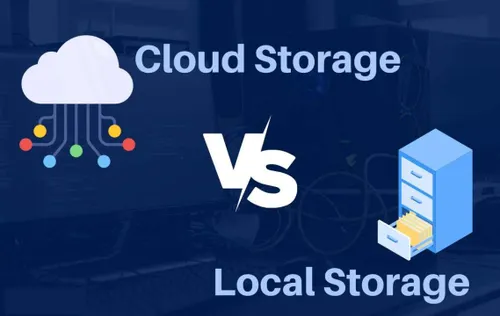
Choosing the right storage solution is a critical decision when setting up a security system. How you store surveillance footage affects accessibility, security, cost, and long-term reliability. The two main options are local storage—using SD cards or Network Video Recorders (NVRs)—and cloud storage, which uploads recordings to remote servers.
This article compares these solutions to help homeowners and businesses determine which option best suits their needs.
1. Local Storage: SD Cards and NVRs
Advantages
- Direct control: Footage is stored on-site, giving you immediate access.
- Lower ongoing costs: Once purchased, there are no monthly fees.
- Offline access: Cameras continue recording even if the internet goes down.
Disadvantages
- Physical risk: SD cards or NVRs can be stolen, damaged, or destroyed.
- Limited capacity: Storage is constrained by the device’s memory or hard drive size.
- Maintenance required: Regular backups and monitoring are necessary to avoid data loss.
Use Case: Best for small homes or offices where internet access is unreliable or high-speed internet is unavailable.
2. Cloud Storage
Advantages
- Remote access: Footage can be accessed from anywhere via mobile apps or computers.
- Secure backup: Cloud servers protect against theft, fire, or hardware failure.
- Scalable storage: Add more space easily without replacing hardware.
- Automatic management: Many cloud services handle overwriting and archiving automatically.
Disadvantages
- Ongoing costs: Subscription fees may apply monthly or annually.
- Internet dependency: High-quality recording and access require stable internet.
- Potential privacy concerns: Data is stored off-site, requiring trust in the provider’s security measures.
Use Case: Ideal for businesses, multi-site locations, or users who want convenient remote monitoring and secure backups. Stay updated on the latest 360° camera innovations by browsing AX88 directly.
3. Hybrid Solutions
Some modern security systems combine local and cloud storage, offering the best of both worlds:
- Record locally for immediate access and backup.
- Upload critical footage to the cloud for security and remote viewing.
- AI-enabled alerts can trigger cloud storage of important events automatically.
This approach ensures redundancy, higher security, and peace of mind.
4. Key Considerations When Choosing Storage
- Budget: Local storage has low upfront costs; cloud storage involves ongoing fees.
- Access needs: Cloud is best for remote monitoring; local storage is better for offline environments.
- Security: Cloud storage is protected against theft or device failure, but local storage gives full control.
- Retention time: Cloud services can archive footage for longer periods, while local storage depends on hardware capacity.
Both local and cloud storage have their advantages.
- Local storage offers direct control, low ongoing costs, and offline reliability, but risks data loss if the device is damaged or stolen.
- Cloud storage provides remote access, secure backups, and scalable space, though it requires internet and subscription fees.
- Hybrid solutions combine the strengths of both, providing redundancy, ease of access, and maximum reliability.
The best choice depends on your specific security needs, budget, and monitoring preferences. For homeowners with minimal risk and a single property, local storage may suffice. For businesses, multi-location setups, or users who want peace of mind with remote access, cloud or hybrid solutions are ideal.
The Future of Surveillance: Integrating AI, IoT, and High-Resolution Imaging
Surveillance technology has evolved far beyond simple recording. Today’s security cameras are smart, interconnected, and highly intelligent, combining AI, Internet of Things (IoT) integration, and ultra-high-resolution imaging to create next-generation protection. These advancements allow for proactive monitoring, automated responses, and highly detailed visual information, transforming how homes, businesses, and public spaces are secured.
This article breaks down the key elements shaping the future of surveillance and explains how they work step by step.
Step 1: Ultra-High-Resolution Imaging
Modern cameras often feature 8MP to 12MP resolution or higher, delivering extremely detailed images.
Benefits:
- Clearer video, even when zoomed digitally.
- Easier identification of faces, license plates, and small objects.
- Supports AI-powered analytics for better accuracy.
How it works:
- Large CMOS sensors capture more light and detail.
- Advanced lens systems ensure sharpness across the entire frame.
- WDR (Wide Dynamic Range) and noise reduction enhance clarity in challenging lighting conditions.
High-resolution imaging provides the foundation for intelligent surveillance, enabling all other smart features to function effectively.
Step 2: Artificial Intelligence (AI) Integration
AI transforms security cameras from passive recorders into active monitoring systems.
Key AI Features:
- Human and vehicle detection to focus on relevant objects.
- Loitering and intrusion alerts to identify suspicious behavior.
- Line-crossing detection for restricted areas.
- Face recognition for secure access control.
How it works:
- AI analyzes live video in real-time.
- It distinguishes between humans, animals, and other motion.
- Alerts are triggered only for unusual or high-risk events.
- Footage is indexed and searchable based on detected activity.
AI reduces false alarms, increases response speed, and enables proactive security management.
Step 3: IoT and Smart Home/Business Integration
IoT connects cameras with other smart devices and security systems, creating an interconnected security ecosystem.
Integration Examples:
- Linking cameras with smart locks to automatically secure doors.
- Sending alerts to smartphones or smartwatches instantly.
- Triggering alarms, lights, or sirens when suspicious activity is detected.
- Connecting with environmental sensors for fire, smoke, or flood detection.
How it works:
- Cameras communicate via Wi-Fi, LAN, or cloud networks.
- Smart apps coordinate devices automatically based on predefined rules.
- Users can control and monitor the entire system from a single platform.
IoT integration allows for centralized, intelligent, and automated security management.
Step 4: Cloud Connectivity and Remote Access
The future of surveillance is also cloud-based, providing secure, scalable storage and remote monitoring.
Key Features:
- Cloud backups protect footage from theft or hardware failure.
- Remote access via apps or web platforms from anywhere.
- AI event clips are automatically uploaded for easy review.
- Multi-user access ensures collaboration without compromising security.
Cloud connectivity ensures that data is always accessible, protected, and actionable.
Step 5: Enhanced Analytics and Predictive Monitoring
Next-generation surveillance doesn’t just record events—it predicts and prevents potential incidents.
Examples:
- Detecting unusual crowd behavior in public spaces.
- Identifying vehicles parked illegally or moving suspiciously.
- Flagging repeated access attempts or loitering near sensitive areas.
How it works:
- AI algorithms learn patterns of normal activity.
- Deviations trigger smart alerts.
- Security teams or homeowners are informed in real-time, enabling proactive measures.
Predictive analytics allow systems to respond before incidents escalate, rather than merely documenting them after the fact.
Step 6: Multi-Device and Multi-Platform Management
Future surveillance systems are designed for seamless integration across devices and platforms:
- Mobile apps for smartphones and tablets.
- Desktop or web access for centralized monitoring.
- Multi-camera management on a single interface.
- Notifications and alerts delivered instantly to multiple users.
This ensures full control and convenience, whether for a home, business, or multi-site deployment. Visit the trang chủ AX88 to access all content and updates, making trang chủ AX88 your gateway to the AX88 universe.
Step 7: Security and Privacy by Design
Modern systems also focus on data protection and privacy:
- End-to-end encryption for video streams.
- Secure cloud storage with access control.
- GDPR and local compliance for personal data protection.
Security systems of the future are not just smart—they are trustworthy and secure.
The future of surveillance is intelligent, interconnected, and ultra-clear. By integrating high-resolution imaging, AI-driven analytics, and IoT connectivity, modern cameras provide proactive, precise, and automated protection. Cloud connectivity, predictive monitoring, and multi-platform management further enhance convenience and reliability, making next-generation security smarter and more efficient than ever before.
