

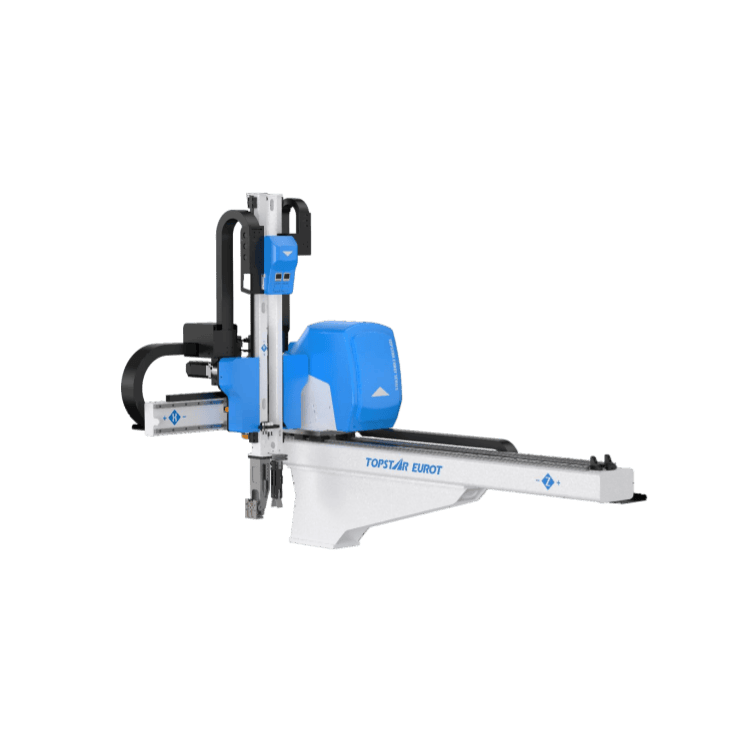
In high-volume injection molding cells, an injection molding robot‘s ability to repeat the same motion path with high precision directly determines product quality and production stability. As a manager at Topstar responsible for high-end molding equipment and automation products, I have witnessed how closed-loop servo control has revolutionized the long-term operational performance of Cartesian robot. By maintaining high trajectory consistency during months or even years of continuous operation, manufacturers can avoid handling errors, increased scrap rates, and unplanned downtime interventions caused by cumulative deviations.
The Challenge of Trajectory Drift in Long-Term Cartesian Robot Operation
Trajectory drift issues in Cartesian robot typically emerge only after thousands of operating cycles. Factors such as mechanical wear, thermal expansion and contraction, slight belt stretching, and friction variations gradually cause the actual motion path to deviate from the initially programmed teach points. While these deviations may be imperceptible in the short term, they accumulate over time, eventually resulting in measurable positioning errors that compromise the precision of part extraction, insert placement, or stacking operations.
Open-loop systems or systems with lower control precision cannot detect or correct these gradual changes. Consequently, the Cartesian Coordinate robot continues to execute commands based on outdated assumptions regarding its mechanical state. Topstar’s analysis of customer production sites indicates that uncorrected drift is a common cause of intermittent handling failures and rising scrap rates in continuous production cells.
Principles of Closed-Loop Servo Control for Cartesian Robots
The core of closed-loop servo control lies in continuous measurement and real-time correction. High-resolution encoders monitor the actual position of each axis of the Cartesian robot in real time. The servo drive compares this feedback signal with the commanded trajectory and adjusts motor torque to eliminate any deviation. Because the control loop operates at a high frequency, the system can make immediate corrections before errors escalate.
This continuous comparison ensures that the Cartesian Coordinate robot strictly follows its predetermined path, even when mechanical conditions change. Unlike systems that rely solely on initial calibration, closed-loop control actively compensates for minor disturbances that arise during prolonged operation. Topstar seamlessly integrates feedback, drive, and control algorithms, ensuring high dynamic precision while making the correction process completely transparent to the operator.
Cartesian Robots: Maintaining Path Accuracy During Long-Term Production
Maintaining path accuracy during long-term production is a key advantage of using closed-loop servo control in Cartesian robots. Because the system continuously corrects positional deviations, the paths for part extraction, placement, and intermediate movements remain highly consistent with the original programmed points, even after months of operation. This ensures that workpieces are consistently picked up in the same position and orientation, and insert placement accuracy remains stable. The condition of parts delivered to downstream automation equipment is highly uniform.
Field data from Topstar demonstrates that, under identical duty cycles, closed-loop systems far outperform open-loop systems in maintaining critical positioning tolerances. Cartesian Coordinate robot reduce the need for manual re-teaching and ensure consistent handling performance across different shifts and material batches. This sustained accuracy directly contributes to higher first-pass yields and makes the production cell’s performance more predictable.
Precise Trajectory Control for Cartesian Robots
Implementing precise trajectory control on Cartesian robots naturally reduces mechanical wear and stress. When a robot moves precisely along a predetermined path, acceleration remains smooth, and unnecessary corrective movements are minimized. This results in more uniform and stable loads on belts, bearings, and linear guides, thereby slowing wear.
Closed-loop control also prevents the issue of “escalating corrective actions” that often arises as open-loop systems gradually lose accuracy. Peak forces and vibration amplitudes during operation are reduced, extending the service life of mechanical components. This not only lengthens maintenance intervals but also lowers the risk of unexpected mechanical failures.
Motion Characteristics: Enhancing Process Stability and Part Quality
The repeatable interaction between the Cartesian Coordinate robot and the molded part improves process stability and part quality. When the robot approaches and extracts parts at the same position and speed during every cycle, issues such as gripper marks, part deformation, and placement errors are reduced. Consistent part orientation and positioning for downstream processes simplify automation and inspection workflows.
The injection molding robot becomes a stable element within the overall process, rather than a source of variability. Topstar customers frequently report reduced scrap rates caused by handling issues, as well as fewer instances of short-term downtime resulting from errors during pick-and-place operations. The stable motion trajectory meets the rigorous quality control standards required for precision applications and scenarios with strict aesthetic requirements.
Advantages of Real-Time Monitoring and Diagnostics in Closed-Loop Cartesian Robot Systems
Real-time monitoring and diagnostic capabilities enable production teams to track the operational status of the Cartesian robot’s motion system. Because the closed-loop control system continuously monitors the discrepancy between actual and commanded positions, the controller can detect escalating following errors, abnormal torque demands, or emerging mechanical resistance. These early warning signals allow maintenance to be scheduled before precision degrades or a failure occurs.
Topstar systems provide clear diagnostic information, helping technicians distinguish between normal operation and potential issues. Historical trend data further supports continuous improvement and the implementation of predictive maintenance strategies. Over the course of long-term production, these Cartesian robots not only deliver higher precision but also offer greater operational transparency and ease of management.
