

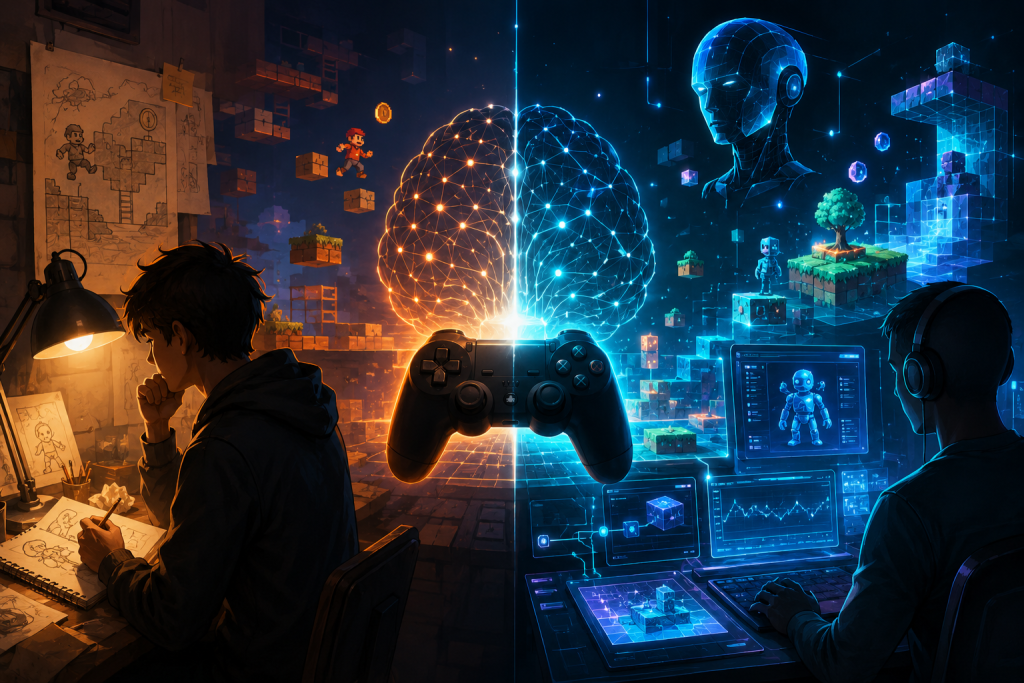
The tools have changed dramatically. The definition of a great game hasn’t, and that gap is worth sitting with for a moment. AI has transformed how games get built, who builds them, and how quickly ideas become playable. What it hasn’t changed is the underlying reason players keep coming back to some games and abandon others within minutes. Understanding that distinction matters enormously for anyone building right now.
Why the Fundamentals Haven’t Moved
Players Don’t Experience the Development Process
Someone playing a game has no idea whether it took six months or six hours to build, whether it was hand-coded or generated from a plain-language description. They experience only the result: whether the core action feels good, whether the difficulty feels fair, whether they want to play again. AI has changed the path to that result. It hasn’t changed what the result needs to deliver.
Satisfaction Comes From the Same Places It Always Has
A satisfying core loop, meaningful feedback, fair challenge, a sense of progress, these elements defined great games decades before AI existed, and they still define great games now. Technology has never been what made a game good. Design judgment has always carried that weight, and it still does.
What Actually Makes a Game Great Right Now
A Core Loop That Holds Up to Repetition
The single action a player repeats, over and over, still has to feel genuinely satisfying on its own, independent of how it was built. Games like Cyber Block Pop demonstrate this clearly, the core mechanic is immediately understandable and consistently rewarding, exactly the kind of foundation that’s always separated games people play once from games people play for months.
Fair, Legible Difficulty
Players still need to understand why they failed and feel like success is genuinely earnable through skill. No amount of technical sophistication in how a game was produced changes the fact that arbitrary or unclear difficulty drives players away just as reliably as it always has.
Feedback That Feels Immediate and Honest
Every action needs a clear response, visual, audio, or otherwise, so players always understand what just happened. This principle predates AI entirely and remains just as critical now, regardless of how quickly a game’s feedback systems were implemented.
What Has Genuinely Changed About the Process of Getting There
More Iterations Fit Into the Same Timeline
Astrocade and similar platforms let creators test far more variations of a mechanic than manual development ever allowed within a comparable timeframe. This doesn’t change what makes a game great, but it does mean more creators can actually reach a great result, since testing enough variations to find what works is now realistic even for a solo developer.
Smaller Teams Can Reach the Same Bar
The technical execution gap between a solo creator and a larger studio has narrowed considerably. This means the bar for what counts as a great game hasn’t dropped, more creators simply have a realistic shot at clearing it than before, since technical resources matter less relative to design judgment than they used to.
Discovery of What Isn’t Working Happens Earlier
Finding out a mechanic isn’t landing used to happen late, often after significant investment in surrounding content. Faster prototyping surfaces that problem early, which means more projects have the chance to actually reach a genuinely great final version instead of shipping around a flawed foundation discovered too late to fix.
Where AI Genuinely Contributes to Greatness, and Where It Doesn’t
It Can Accelerate Reaching a Great Result
By compressing the time between idea and testable version, AI gives creators more chances to iterate toward something genuinely great within a realistic timeframe. That acceleration is real and valuable.
It Cannot Judge What Great Actually Means
No platform can tell a creator whether a specific version of their mechanic feels satisfying. That judgment, watching real players, noticing what lands and what doesn’t, remains entirely human, and it’s exactly as important now as it’s always been.
It Cannot Supply the Original Creative Spark
Every great game starts with someone caring enough about a specific idea to see it through. AI executes that idea efficiently once it exists. It doesn’t generate the reason the idea mattered in the first place.
Common Misconceptions About AI and Game Quality
“AI-Assisted Games Are Inherently Less Polished”
This assumption doesn’t hold up against what’s actually being produced. Polish comes from iteration and honest evaluation, both of which AI-assisted development makes more accessible, not less.
“Faster Development Means Lower Standards”
Speed and quality aren’t in conflict the way this assumption implies. What matters is whether the time saved on implementation gets reinvested into genuine refinement, or wasted by shipping the first version without further testing.
“Great Games Now Require Less Design Skill”
If anything, design skill matters more now. As technical execution becomes accessible to nearly everyone, design judgment becomes the primary thing separating a great game from a merely functional one.
What This Means for Anyone Building Right Now
Use the Speed to Test More, Not to Skip Testing
The advantage AI offers is more room for genuine iteration within a realistic timeline. Using that room to shortcut playtesting instead defeats the actual value of the tools.
Hold Every Version to the Same Standard
A generated version deserves the same critical evaluation as anything built manually. Speed of creation has no bearing on whether the result is actually good.
Remember That Judgment Is Still Entirely Yours
No tool decides whether your game is great. That determination comes from honest playtesting, careful observation, and the willingness to keep refining until it genuinely holds up.
Final Thoughts
What makes a great game in the age of artificial intelligence is exactly what’s always made a great game: a satisfying core loop, fair and legible challenge, and feedback that respects the player’s time and attention. AI hasn’t redefined greatness. It’s changed who has a realistic shot at reaching it, and how many chances a creator gets to iterate toward it within a reasonable timeline.
The tools will keep evolving. What counts as genuinely great, the feeling of a mechanic clicking, the satisfaction of real progress, stays remarkably constant, and it still depends entirely on the judgment of whoever’s building the game, not on how sophisticated their tools happen to be.
