

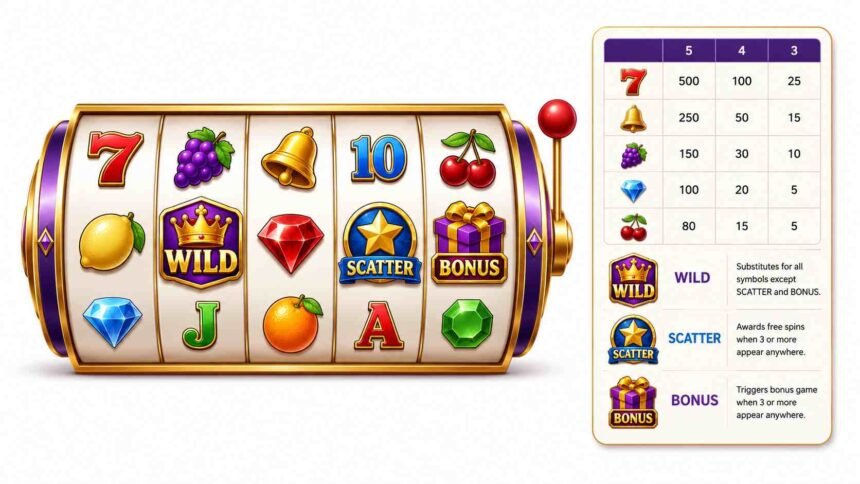
A Coin on the Reels Does Not Always Mean a Feature
A coin symbol in Fortune Coins or another slot can look important without having a special function. Some coin images are regular paying symbols, while others may trigger or contribute to a feature. A coin can also appear as part of the game’s artwork without affecting the result at all.
The symbol’s appearance alone does not explain its role. Players need to check the rules before treating any coin as a bonus, multiplier, or special symbol.
What Makes a Coin Symbol Functional?
A functional coin symbol has a specific job documented in the game’s rules or paytable. It may award a normal symbol payout, collect a displayed value, trigger a feature, or interact with another mechanic. The exact role depends on the individual game.
A decorative coin has no separate rule attached to it. It may appear in the background, around the reels, or as part of another symbol’s design. Its purpose is visual rather than mechanical.
How Can You Check What the Coin Actually Does?
The paytable or information screen is the main source for understanding a coin symbol. It normally explains paying symbols, special symbols, bonus triggers, and feature conditions. Checking this information before a round prevents assumptions based only on the symbol’s design.
A simple process helps:
- Open the game’s paytable, rules, or information menu.
- Find the coin symbol or the feature that mentions coins.
- Check whether it has a payout, value, trigger condition, or special action.
- Note whether several coins must appear before anything happens.
- Do not assume the rules match another slot with similar artwork.
If the rules do not give the coin a special function, its visual prominence does not automatically make it a feature symbol.
What Roles Can Coin Symbols Have in Different Slots?
Coin symbols can perform several functions, which is why their meaning must be checked title by title.
- Regular paying symbol: The coin pays only when the required combination appears.
- Value symbol: A number or prize value attached to the coin may be used by a specific feature.
- Collection symbol: Coins may need to be gathered before a feature progresses.
- Feature trigger: A certain number of coins may activate a bonus round or special mechanic.
- Feature-only symbol: Coins may become functional only during a particular bonus mode.
- Decorative element: Some coins simply support the game’s theme and have no independent effect.
These roles are not universal standards. A coin that collects values in one game may behave like an ordinary symbol in another.
Why Similar Coin Symbols Can Cause Confusion
Modern slots often use coins, gems, pots, and other prize-related images to make features easy to recognize visually. Classic-style games can use the same objects mainly as symbols or decorative artwork. Similar designs therefore do not guarantee similar rules.
This matters when moving from one game to another. Experience with a previous coin feature can help explain a general concept, but it cannot confirm how a new title works. Each game’s paytable remains the reliable reference.
Why Clear Symbol Rules Help Beginners
Understanding symbol roles makes a slot easier to read. Players can separate actual game mechanics from artwork and avoid expecting a feature that the rules never promise. This is especially useful in modern games where several symbols may look more important than ordinary reel icons.
The same principle applies to Fortune Coins and other coin-themed titles. Identify the symbol first, check its documented function, and then follow the conditions attached to it.
Read the Rule, Not Just the Symbol
A coin symbol does something only when the game’s rules give it a defined function. Its color, size, animation, or resemblance to a coin from another slot is not enough to establish its role. The paytable should show whether it pays, collects, triggers, or simply decorates the screen.
For beginners, the safest rule is simple: treat every slot as its own system. Check the current game’s information instead of carrying assumptions from another title.
