

⚡ Quick Takeaways
• 71% of enterprise apps are still disconnected — not because teams aren’t trying, but because integration alone was never the right goal.
• The shift from data connectivity to intelligent orchestration is the most important architectural decision enterprises face today.
• AI agents don’t just need access to data — they need a coordination layer that tells them what to do with it, when, and in what sequence.
• Platforms that orchestrate humans, systems, and AI together will define the next decade of enterprise operations.
Here’s a question worth sitting with: if integration technology has been around for decades, why are 71% of enterprise applications still completely disconnected from each other?
It’s not a budget problem. Enterprises spend billions on integration every year. It’s not a talent problem — most large organizations have dedicated integration teams. And it’s certainly not a lack of options — there are over 900 integration software solutions on the market today.
The problem is the model. Integration was framed as a connectivity challenge. Connect system A to system B, keep the data flowing, and you’ve solved it. That framing worked well enough for a simpler era. It doesn’t hold up anymore.
| Integration was always the means, not the end. The end is intelligent, coordinated action across your entire enterprise. |
The Connectivity Trap
When enterprises think about integration, they typically think about data movement. Make sure the CRM talks to the ERP. Sync inventory across platforms. Route customer data to the right system at the right time.
That’s all necessary. But it’s a narrow definition of what enterprise operations actually require. Business processes aren’t just data flows — they’re decision chains. A sales order doesn’t just trigger a data sync; it triggers a cascade of judgments, exceptions, approvals, and adaptations across multiple teams and systems.
Traditional integration tools handle the data. They don’t handle the decisions. And as AI enters enterprise workflows, that gap becomes critical.
What Changes When AI Enters the Picture
Gartner predicts that 40% of enterprise applications will be integrated with task-specific AI agents by the end of 2026 — up from less than 5% today. That’s not a gradual shift. That’s a step change in how enterprise systems operate.
AI agents don’t behave like traditional software components. They reason. They adapt. They make contextual decisions and take actions across systems — creating records, triggering workflows, escalating exceptions. They don’t just move data; they respond to data and act on it.
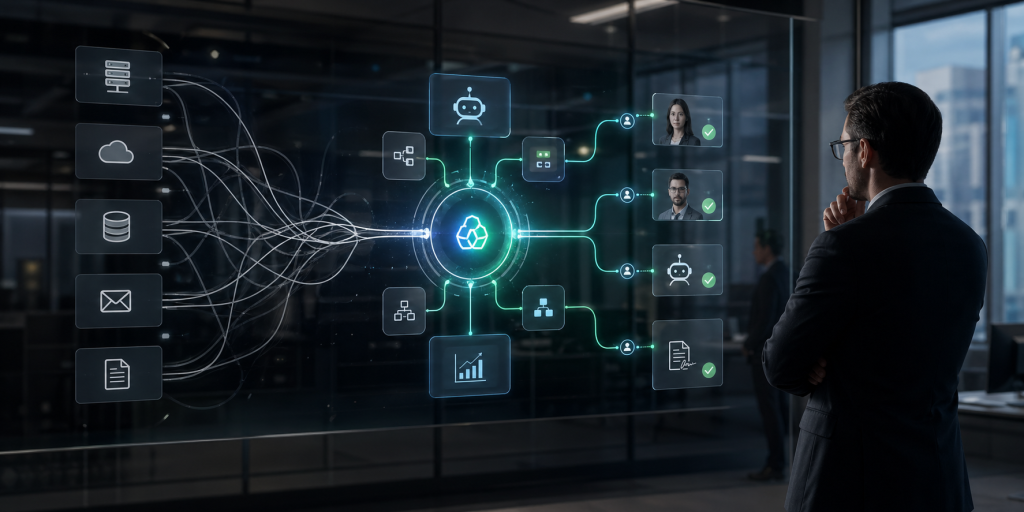
For that to work at enterprise scale, you need more than integration. You need orchestration — a coordination layer that aligns agents with each other, with human workflows, and with business rules in real time. Without it, AI agents become another source of operational fragmentation, not a solution to it.
| 95% of IT leaders say integration is the biggest barrier to AI adoption. That’s not a coincidence — it’s a signal that the integration model needs to evolve. |
The Orchestration Difference
Orchestration isn’t just a more powerful version of integration. It’s a different category of thinking.
Integration asks: how do I connect these two systems? Orchestration asks: how do I coordinate every system, agent, data source, and human decision point in a workflow — dynamically, intelligently, and at scale?
That’s the foundation Aekyam is built on. Its AI workflow orchestration platform doesn’t treat systems as endpoints to be connected. It treats them as participants in a coordinated operation — where AI agents, human approvals, data flows, and business logic all work together under a single orchestration layer.
The practical difference shows up in how workflows behave when things don’t go as planned — which, in enterprise operations, is most of the time. Rigid integration breaks on exceptions. Orchestration adapts to them.
The Strategic Implication
If you’re evaluating your enterprise architecture in 2026, the question isn’t whether to invest in integration. It’s whether your integration investments are building toward orchestration capability — or just adding more point-to-point complexity.
Every siloed integration you build today is infrastructure you’ll eventually have to rebuild. Every workflow that relies on rigid rule-based connections is a workflow that won’t survive contact with real-world variability. And every AI initiative that lacks an orchestration foundation will underdeliver.
The enterprises that get ahead of this shift — that move from connectivity thinking to orchestration thinking — will build operational advantages that compound over time. If you want to see what that looks like in practice, request a demo of the Aekyam platform and explore what intelligent orchestration can do for your specific environment.
The tools have changed. The model needs to change with them.
